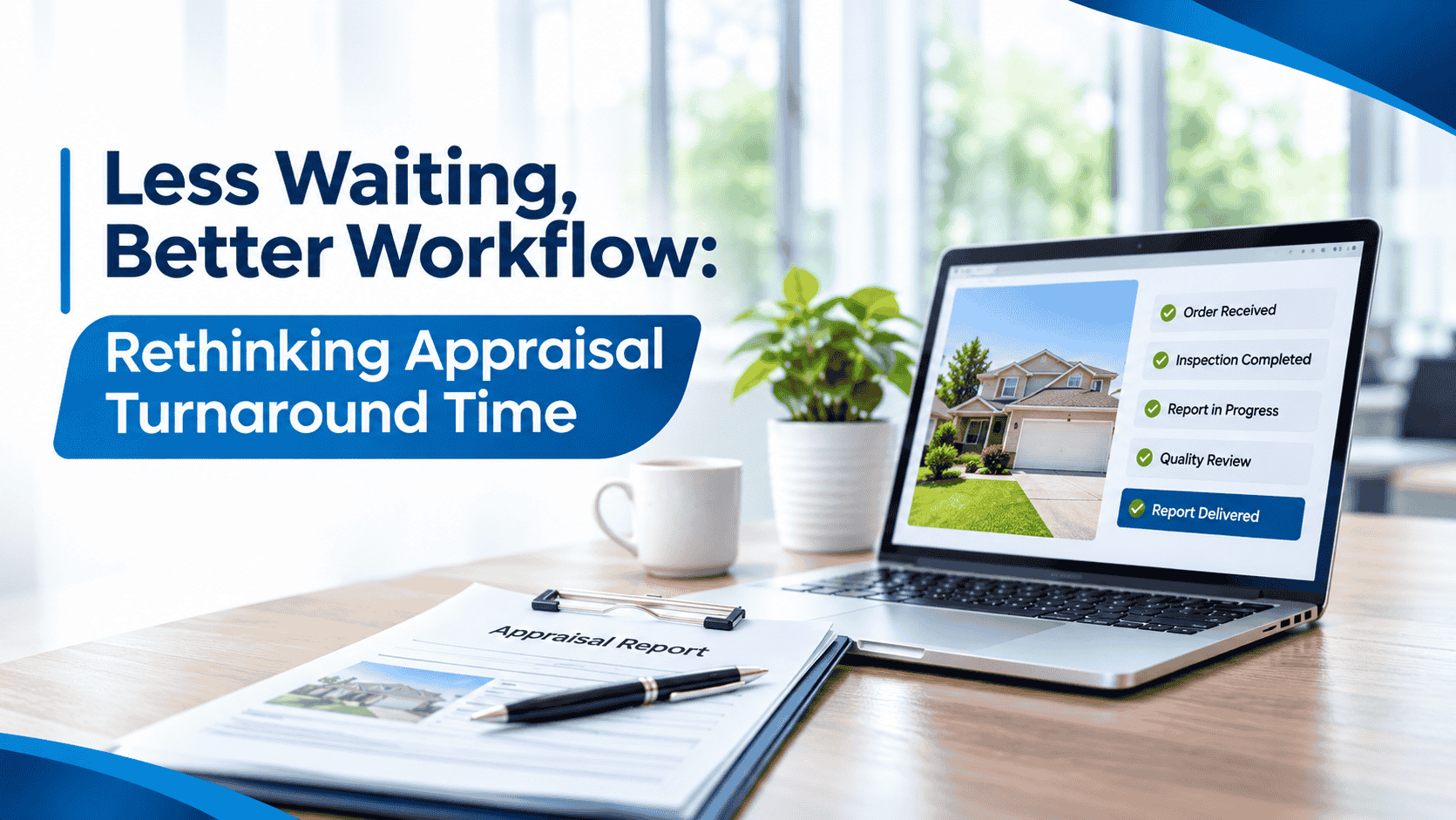
In the mortgage and real estate industry, timing matters. Whether a lender is processing a purchase loan or an Appraisal Management Company (AMC) is managing multiple appraisal orders, every step needs to move forward without unnecessary delays. One of the most important factors influencing this process is appraisal turnaround time.
Think about it. A borrower is waiting for a mortgage decision, a lender needs an accurate property valuation, and an appraiser is managing inspections, research, report writing, and other assignments. Even a small delay in one part of the process can affect everything that follows.
For AMCs and mortgage lenders, managing appraisal turnaround time is not simply about getting reports completed faster. It is about maintaining a balance between speed, accuracy, quality, and compliance.
So, what determines appraisal turnaround time? Why do some appraisal orders take longer than others? And what can appraisal companies do to improve their workflows?
Let’s take a closer look.
What Is Appraisal Turnaround Time?
Appraisal turnaround time refers to the total time required to complete an appraisal assignment, from the placement of an appraisal order to the delivery of the completed appraisal report.
In a typical mortgage appraisal workflow, this includes several activities:
- Receiving and reviewing the appraisal order
- Assigning the order to a qualified appraiser
- Scheduling the property inspection
- Conducting the property inspection
- Researching comparable properties and market conditions
- Preparing the appraisal report
- Reviewing the report for accuracy and completeness
- Making necessary corrections or revisions
- Delivering the final report to the client
The exact timeline depends on the property type, location, assignment complexity, appraiser availability, and the efficiency of the appraisal workflow.
Appraisal turnaround time measures how efficiently an appraisal moves from order placement to final report delivery.
It is important to understand that a shorter turnaround time does not automatically mean better service. An appraisal report must still meet applicable requirements and provide reliable property valuation information.
Why Is Appraisal Turnaround Time Important in Mortgage Lending?
An appraisal is an important part of the mortgage lending process because it helps lenders understand the value of the property being used as collateral.
When appraisal reports are delayed, other activities in the loan process may also be affected. Here are some reasons why turnaround time matters.
1. It Helps Keep Mortgage Closings on Schedule
Homebuyers and sellers often work around specific closing dates. Lenders need appraisal results to complete important underwriting and collateral review activities.
When an appraisal report arrives late, the lender may have less time to review the valuation, address questions, and complete the remaining loan requirements. This can create additional pressure on everyone involved.
2. It Improves the Borrower Experience
Buying a home can already be a stressful experience. Borrowers are waiting for updates, completing documentation, and coordinating with multiple parties.
When appraisal delays occur, uncertainty increases. A more predictable appraisal process helps lenders provide better communication and keeps borrowers informed about their loan progress.
3. It Supports Better AMC Operations
AMCs manage appraisal orders, coordinate with appraisers, communicate with lenders, and monitor report quality.
When orders are delayed, operations teams often spend more time following up, checking assignment status, and resolving administrative issues. Efficient turnaround time management allows teams to manage workloads more effectively.
4. It Helps Lenders Manage Loan Pipelines
Mortgage lenders need a clear understanding of where each loan stands.
If appraisal reports are consistently delayed, it becomes harder to estimate completion timelines and coordinate underwriting activities. Reliable appraisal workflows help lenders maintain better visibility into their loan pipelines.
What Is the Average Appraisal Turnaround Time?
There is no single standard appraisal turnaround time that applies to every property or assignment.
For planning purposes, residential appraisal assignments may take several business days to a couple of weeks, depending on market conditions and assignment complexity. However, this should not be treated as a guaranteed industry benchmark.
A standard single-family residential appraisal may move faster than an assignment involving a rural property, a complex valuation, or a property with limited comparable sales.
The actual timeline can depend on:
- Property location and accessibility
- Appraiser availability
- Inspection scheduling
- Property type and complexity
- Availability of comparable sales
- Required appraisal scope and reporting requirements
- Client specific review procedures
- Revisions and additional documentation
For this reason, AMCs and lenders should monitor their own historical turnaround time data rather than relying on one general industry estimate.
8 Factors That Can Affect Appraisal Turnaround Time
Understanding what causes delays is the first step toward improving appraisal operations. Let’s explore eight common factors that can influence appraisal turnaround time.
1. Appraiser Availability
One of the most common challenges is finding an available appraiser who is qualified to handle the assignment.
Appraiser availability can vary depending on location, workload, property type, and assignment requirements.
For example, an appraisal in a busy metropolitan area may have several available appraisers, while a property in a rural location may require additional coordination. When an assignment cannot be placed quickly, the entire timeline gets pushed back.
What can be done?
AMCs can maintain an updated network of qualified appraisers, monitor workload distribution, and identify potential coverage gaps before they become major problems.
2. Property Inspection Scheduling
Once an appraiser accepts an assignment, the next step is usually coordinating the property inspection. However, scheduling is not always straightforward.
The homeowner may have limited availability. The property may be tenant occupied. There may also be access restrictions or communication gaps between the appraiser and the property contact.
Even when an appraiser is ready to proceed, inspection scheduling can create delays.
What can be done?
Clear communication, accurate contact information, and timely scheduling follow-ups can help reduce unnecessary waiting time.
3. Incomplete Property Information
Missing or incorrect property information can slow down the appraisal process.
For example, an appraisal order may contain incomplete property details, incorrect contact information, missing access instructions, or inconsistent loan information.
The appraiser or AMC may need to request clarification before proceeding. These small issues can create repeated communication and additional administrative work.
What can be done?
Review appraisal orders carefully before assigning them. Confirm essential property details and ensure that the information provided is complete and consistent.
4. Complex Property Characteristics
Not every property is straightforward to evaluate.
A standard residential property may have readily available comparable sales, while a unique property may require more research.
Properties with unusual features, large acreage, mixed-use characteristics, or limited comparable sales can require additional analysis. As a result, the appraiser may need more time to complete the valuation and prepare a well-supported report.
What can be done?
Identify complex assignments early and allow appropriate time for research and reporting. Assigning the right appraiser based on property experience can also make a difference.
5. Comparable Property Research
Comparable sales play an important role in developing a credible property valuation.
Appraisers research recently sold properties and evaluate similarities and differences to support their conclusions.
However, finding suitable comparable properties can take time, especially in areas with limited sales activity or unusual property characteristics. Additional research may be necessary to support adjustments and explain market conditions.
What can be done?
Provide accurate property information at the beginning of the assignment and make sure the appraiser has access to relevant assignment details. The valuation analysis itself must remain the responsibility of the qualified appraiser.
6. Report Writing and Documentation
Completing the property inspection is only one part of the appraisal process.
The appraiser must also analyze the property, document relevant information, prepare the report, and ensure that the required sections are complete.
When appraisers are managing multiple assignments, report preparation and administrative responsibilities can compete for their time. This is where inefficient workflows can become a problem.
What can be done?
Organized documentation, standardized administrative processes, and appropriate back-office support can help reduce repetitive administrative work while allowing appraisers to focus on valuation analysis and professional judgment.
7. Appraisal Review and Revisions
Once an appraisal report is submitted, it may go through a quality review process.
During this stage, reviewers may identify missing information, inconsistencies, incomplete explanations, or other issues that require clarification.
If revisions are needed, the report may move back and forth between the reviewer and appraiser. Repeated revision requests can increase turnaround time.
What can be done?
Use a consistent quality control checklist before report submission. Review documentation for completeness and identify obvious administrative issues early.
Review processes should support accuracy and compliance rather than simply prioritize faster report delivery.
8. Communication Gaps Between Stakeholders
Appraisal assignments involve multiple people, including lenders, AMCs, appraisers, property contacts, and review teams.
When communication is unclear, important updates can get missed.
An inspection may be waiting for confirmation, an appraiser may need additional property information, or a reviewer may be waiting for a response. Without proper follow-up, these situations can remain unresolved longer than necessary.
What can be done?
Establish clear communication responsibilities, track pending requests, and maintain regular status updates throughout the appraisal workflow.
How Can AMCs Improve Appraisal Turnaround Time?
Improving appraisal turnaround time requires more than asking appraisers to complete reports faster.
AMCs need to examine the complete workflow and identify where unnecessary delays occur. Here are some practical ways to improve the process.
1. Standardize the Appraisal Order Intake Process
Start by reviewing every new appraisal order before assigning it.
Make sure the property address, assignment requirements, contact information, and other essential details are accurate.
A standardized intake checklist can help prevent avoidable delays caused by incomplete information.
2. Improve Appraiser Assignment and Allocation
An efficient assignment process helps ensure that orders reach qualified appraisers without unnecessary waiting.
AMCs should consider location, appraiser qualifications, current workload, and assignment complexity when allocating orders.
Monitoring assignment acceptance and completion patterns can also help identify operational bottlenecks.
3. Track Every Stage of the Appraisal Workflow
Knowing that an appraisal is delayed is useful. Knowing exactly where it is delayed is even more valuable.
AMCs should monitor important workflow stages, such as:
- Order received
- Order assigned
- Assignment accepted
- Inspection scheduled
- Inspection completed
- Report in progress
- Report submitted
- Review completed
- Final report delivered
Tracking these stages helps operations teams identify recurring delays and take action before they affect other assignments.
4. Reduce Administrative Workloads
Appraisers and appraisal operations teams handle several responsibilities beyond the valuation itself.
These may include documentation management, data entry, status updates, report formatting, and routine administrative follow-ups.
When too much time goes into repetitive tasks, less time is available for core appraisal activities.
Organized administrative support can help streamline these responsibilities and keep workflows moving.
5. Establish a Consistent Quality Review Process
A report that requires multiple rounds of revisions can take longer to complete than one that is properly reviewed before submission.
A structured quality review process helps identify missing information and documentation issues early.
The goal should be to reduce avoidable revisions without compromising the appraiser’s independent analysis or applicable appraisal requirements.
6. Use Technology to Improve Workflow Visibility
Technology can make it easier to manage large volumes of appraisal assignments.
Appraisal management systems and workflow tools can help teams monitor order status, organize documents, track deadlines, and manage communication.
However, technology works best when supported by clear processes and people who understand the workflow.
How Does Appraisal Data Entry Affect Turnaround Time?
Appraisal data entry may seem like a small part of the overall process, but it can influence how efficiently appraisal assignments move forward.
Accurate data entry helps maintain organized property information, assignment records, and supporting documentation.
On the other hand, incomplete or incorrect information can create additional verification work, clarification requests, and unnecessary delays.
Consider a example.
An AMC receives multiple appraisal orders throughout the day. If property details, assignment information, and supporting documents are not entered or organized correctly, the operations team may need to spend additional time checking records and correcting information.
These individual tasks may appear minor, but when repeated across hundreds of orders, they can affect overall operational efficiency.
This is why structured data management and reliable administrative processes are important.
Appraisal data entry support can assist with organizing relevant information and maintaining accurate records. It should complement the appraiser’s professional responsibilities, not replace independent valuation analysis or required review procedures.
What Metrics Should AMCs Track to Measure Appraisal Turnaround Time?
If an AMC wants to improve its turnaround time, it needs to understand its current performance.
Tracking a few operational metrics can help identify where the process is working and where improvements are needed.
1. Average Order-to-Delivery Time
Measures the average time between receiving an appraisal order and delivering the final report.
2. Assignment Acceptance Time
Measures how long it takes for an appraiser to accept an assignment after it is placed.
3. Inspection Scheduling Time
Tracks the time between assignment acceptance and the scheduled property inspection.
4. Inspection-to-Submission Time
Measures how long it takes to submit the report after the property inspection is completed.
5. Revision Rate
Shows how frequently submitted appraisal reports require corrections or additional information.
6. On-Time Completion Rate
Measures the percentage of appraisal assignments delivered within the agreed timeline.
7. Pending Order Volume
Shows how many appraisal assignments are still waiting at different workflow stages.
These metrics give AMCs a clearer understanding of their operations. They can also help identify whether delays are related to appraiser availability, inspection scheduling, administrative processes, or report reviews.
How Can Outsourcing Support Improve Appraisal Operations?
As appraisal volumes change, AMCs and appraisal firms may find it difficult to manage every administrative responsibility internally.
Hiring additional full-time staff is not always the most practical option, particularly when workloads fluctuate.
This is where specialized outsourcing support can become useful.
Outsourcing selected administrative activities can help appraisal businesses manage repetitive tasks while keeping their internal teams focused on important operational and valuation responsibilities.
Depending on the engagement and applicable requirements, support may include:
- Appraisal data entry
- Document organization and management
- Administrative processing
- Appraisal order data management
- Report-related administrative support
- Routine status tracking and coordination
The objective is not simply to transfer work to an external team. It is to build a more organized process that supports consistency, reduces administrative pressure, and improves workflow visibility.
When evaluating an outsourcing partner, AMCs should consider data security, confidentiality, process documentation, quality checks, turnaround commitments, and the ability to work within established client requirements.
Final Thoughts
Appraisal turnaround time is an important part of efficient mortgage and appraisal operations. It affects how AMCs manage assignments, how lenders coordinate their loan pipelines, and how smoothly borrowers move through the mortgage process.
However, improving turnaround time does not mean sacrificing appraisal quality or asking professionals to rush their work.
Real improvement comes from understanding the complete workflow, identifying recurring bottlenecks, maintaining accurate information, improving communication, and reducing unnecessary administrative tasks.
For AMCs, appraisal firms, and mortgage lenders, a well-organized appraisal process can make a meaningful difference in daily operations.
At GoSourceVal, we understand the importance of efficient appraisal workflows and dependable operational support. By focusing on organized processes and administrative efficiency, appraisal businesses can better manage their workloads while keeping accuracy and quality at the center of their operations.
Frequently Asked Questions About Appraisal Turnaround Time
1. What factors affect appraisal turnaround time?
Appraisal turnaround time depends on several factors, including appraiser availability, property location, inspection scheduling, property complexity, comparable sales research, report preparation, and quality review. Incomplete property information and communication gaps can also create delays.
2. How can appraisal management companies reduce turnaround time?
Appraisal management companies can improve turnaround time by streamlining order intake, assigning qualified appraisers efficiently, tracking order progress, improving communication, and reducing repetitive administrative tasks. Consistent quality checks can also help prevent unnecessary report revisions.
3. Why are residential appraisal reports taking longer to complete?
Residential appraisal reports may take longer because of limited appraiser availability, scheduling difficulties, complex property characteristics, insufficient comparable sales, or additional documentation requirements. High appraisal volumes and repeated revision requests can also affect completion timelines.
4. How can AMCs manage a high volume of appraisal orders efficiently?
AMCs can manage high appraisal volumes through organized order management systems, standardized workflows, accurate data entry, regular status tracking, and effective communication with appraisers and lenders. Administrative support can also help internal teams manage repetitive tasks more efficiently.
5. Does appraisal data entry affect appraisal turnaround time?
Yes. Inaccurate or incomplete appraisal data can lead to verification requests, documentation errors, and additional administrative work. Accurate data entry and organized records help reduce avoidable delays and keep appraisal assignments moving through the workflow.
6. Can outsourcing appraisal support services improve operational efficiency?
Yes. Outsourcing selected administrative activities, such as appraisal data entry, document management, and report-related administrative support, can reduce the workload on internal teams. This allows AMCs and appraisal firms to focus more on core operations, quality management, and client requirements.
Looking to Make Your Appraisal Operations More Efficient?
Reduce administrative pressure, improve workflow efficiency, and keep your appraisal assignments moving with dependable operational support from GoSourceVal.